The Complete Guide to GEO in 2026: How to Build Visibility in AI Search and Answers
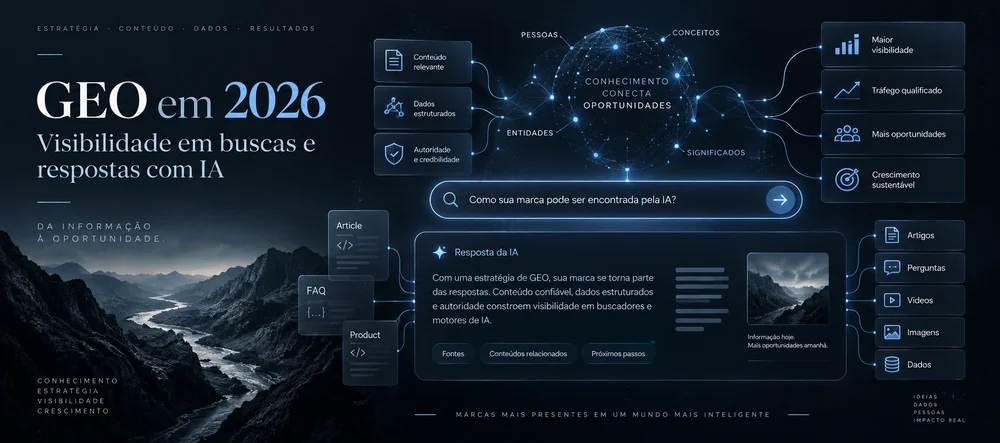
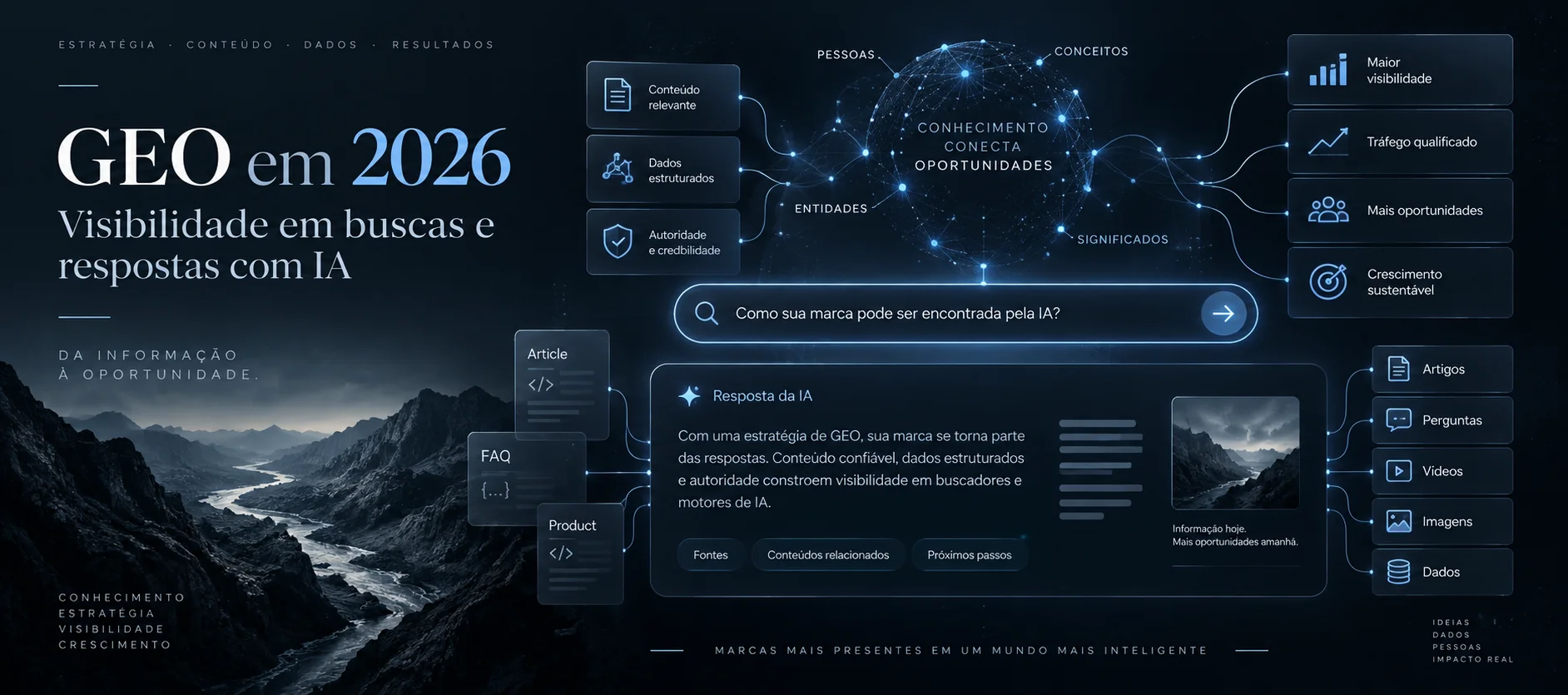
In GEO, the goal isn't to trick AI, but to produce a source that deserves to be found, understood, trusted, and referenced
GEO (Generative Engine Optimization) is the discipline of making content and brands easier to discover, understand, select, and cite in AI-powered search and answer experiences. In 2026, that includes engines like ChatGPT Search, Google AI Overviews and AI Mode, Perplexity, and other systems that combine information retrieval, search engines, and generative models.
GEO doesn't replace SEO. Technical SEO fundamentals, useful content, crawlability, brand authority, and semantic clarity remain the foundation. The difference is that now it's not enough to compete for a spot on the SERP; it also matters to increase the odds of your information being retrieved and used inside a synthesized answer.
What Is GEO?
Generative Engine Optimization is a term used to describe optimization practices aimed at visibility in generative engines. The expression gained academic traction with the paper GEO: Generative Engine Optimization, published at KDD 2024, which proposed a framework for studying visibility in answers generated by generative engines.
It's important to separate academic research, observed best practices, and each platform's official rules.
Why does GEO matter in 2026? The discovery journey has become more fragmented. Users may start a search on Google, ChatGPT, a corporate assistant, YouTube, social media, or engines that answer the question directly. For B2B brands, technology companies, and businesses with complex sales cycles, showing up as a reference during that research can influence trust before the first sales contact even happens.
That changes the strategic question. Instead of just asking “how do I rank first for this keyword?”, it starts to make sense to ask: which sources do these systems retrieve when someone asks the questions that come before buying my service?
SEO and GEO: What's the Real Difference?
SEO and GEO overlap heavily, but they aren't identical:
Traditional SEO: Seeks to maximize discovery, relevance, and performance in search engines, with metrics like impressions, positions, CTR, organic traffic, conversions, and revenue.
GEO: Adds a layer of analysis around presence in AI-generated answers, appearing as a supporting source, brand mentions, referral traffic from assistants, and influence on conversational queries.
In practice: SEO remains the infrastructure for GEO across many environments. Google explicitly states that SEO fundamentals remain relevant for AI Overviews and AI Mode, and that there are no additional technical requirements or mandatory special markup to appear in these features.
The best strategy in 2026 is to treat SEO and GEO as components of the same digital discovery system, not as rival disciplines.
The 4 Pillars of a Defensible GEO Strategy
1. Content that offers genuinely useful information: Generic content can be indexed and even retrieved, but it offers few reasons to be chosen as a source when more specific, original, and well-founded alternatives exist. The most valuable asset for GEO is information that reduces uncertainty: original analyses, benchmarks, and original data; experiments with a described methodology; technical comparisons with explicit criteria; case studies with context, decision, and outcome; clear definitions and direct answers to real questions.
2. Entity, authority, and verifiable reputation: A brand needs to be understandable as an entity. That involves consistency of name, description, services, authors, address where applicable, official profiles, institutional pages, and external mentions. The goal isn't to fabricate signals, but to reduce ambiguity about who the company is, what it does, and why it has legitimacy on that topic.
3. Technical architecture and crawlability: Excellent content that can't be crawled, indexed, or technically interpreted loses opportunities even before the selection stage. Check robots.txt, HTTP responses, canonicalization, indexability, rendering, internal links, sitemap, and access for relevant crawlers. In OpenAI's ecosystem, official documentation states that any public site can appear in ChatGPT Search and recommends not blocking OAI-SearchBot so content can be discovered, displayed, cited, and linked. Inclusion, however, isn't guaranteed.
4. Semantic clarity and editorial structure: Well-organized headings, explicit definitions, focused paragraphs, tables when there's a comparison, lists when there are criteria, and a coherent internal architecture make both human reading and information extraction easier. Structured data helps search engines understand information about the page and the organization, but it needs to accurately represent the visible content — it shouldn't be treated as a “shortcut” capable of guaranteeing presence in AI answers.
What Actually Changed in 2026
ChatGPT Search — think web discovery, not just training: A strategy based only on “publish before the model's cutoff” is outdated for search scenarios. ChatGPT can search the web and use current results. For sites, OpenAI recommends allowing OAI-SearchBot and states that results are ranked using multiple factors aimed at relevance and trustworthiness. OpenAI also states that ChatGPT referral URLs may include the utm_source=chatgpt.com parameter, letting you track part of the traffic received in analytics tools.
Google AI Overviews and AI Mode — SEO remains the foundation: Google states there's no mandatory special technical optimization to appear in AI Overviews or AI Mode. A page needs to be indexed and eligible to appear in Search with a snippet. Google recommends useful and trustworthy content, allowed crawling, good internal link structure, important content available as text, and structured data consistent with the visible content. This position corrects a common GEO myth: there's no need to create “for AI” files, secret markup, or a special schema.org for Google's generative features.
Search Console — now with specific generative AI measurement: In 2026, Search Console started offering a generative AI performance report for Search. The report includes impressions coming from AI Overviews and AI Mode, and lets you analyze pages, devices, and countries associated with those impressions. Access may depend on rollout and having enough data volume. That's different from claiming Search Console shows every phrase where a brand was “cited” — the officially documented metric is exposure and performance in Search's generative features.
Schema and JSON-LD: Use It to Disambiguate, Not to Promise Citations
For Organization, Google recommends applicable properties like name, alternateName, url, logo, address, telephone, and other documented properties. The markup should reflect real facts about the organization and be validated.
Example of an Organization, with Zion's real data:
{
  "@context": "https://schema.org",
  "@type": "Organization",
  "name": "Zion Software House",
  "url": "https://zionsoftwarehouse.com.br/",
  "logo": "https://blog.zionsoftwarehouse.com.br/favicon.svg",
  "description": "Brazilian software house based in Florianópolis, specializing in web development, apps, staff augmentation, and GEO.",
  "sameAs": [
    "https://www.instagram.com/zionsoftwarehouse/",
    "https://www.linkedin.com/company/zionsoftwarehouse/"
  ]
}
Regardless of the organization, the markup should reflect exactly the official, verified data — never generic or outdated information.
8 Practical Steps for a GEO Strategy
Step 1 — Define your topical map: Choose the territories where the company wants to be recognized and organize content as a cluster, not as isolated posts. For a software house, that can include web development, application architecture, modernization, applied AI, performance, security, and GEO.
Step 2 — Map discovery and decision questions: List questions that come up before a purchase, a hire, or a technical choice — for example: which architecture makes sense for this scenario? What's the difference between option A and option B? When is it worth hiring a software house? What risks should I evaluate before migrating an application? How do I measure the return of a GEO initiative?
Step 3 — Run competitive analysis by answer, not just by SERP: Test representative queries across different engines and record which domains, pages, authors, and content types show up. The goal isn't to assume one isolated answer represents a rule, but to identify patterns worth investigating.
Step 4 — Produce citable assets: A page deserves to be cited when it offers something the answer loses by ignoring it: a data point, a method, a particularly clear definition, a comparison, a result, a tool, a study, or a documented experience.
Step 5 — Secure technical access: Run periodic audits of robots.txt, CDN/WAF, indexability, HTTP status, and crawler logs. For ChatGPT Search, specifically check that OAI-SearchBot isn't blocked. For Google, keep Googlebot and indexing within Search best practices.
Step 6 — Structure content for answers: Use titles that match real problems, answer the main question early, develop details afterward, and use lists or tables when the information has a natural structure.
Step 7 — Build external proof: Authority isn't born solely on your own domain. Technical PR, community participation, relevant contributions, studies cited by third parties, consistent official profiles, and author pages help form an ecosystem of trust.
Step 8 — Measure, learn, and update: Monitor visibility in generative engines with a repeatable methodology. Record the query, platform, date, location when relevant, answer, sources shown, and observed changes. Combine this with Search Console, analytics, referral traffic, and business data.
How to Measure GEO Without Inventing a Magic Metric
There's no universally accepted KPI for GEO. Good measurement uses a set of signals:
- Share of voice across a controlled set of questions
- Frequency of appearing as a source or link
- Impressions in Google's generative features, when available in Search Console
- Referral traffic from AI platforms
- Brand searches and growth in direct demand
- Leads who report discovering you through AI engines
- Conversions and revenue tied to pages with organic and generative exposure
The most important thing is keeping the set of queries and the measurement process consistent. Generative answers vary; measuring occasionally can lead to wrong conclusions.
The Experiment That Could Turn Zion Into a Source, Not Just a Commentator
One of the biggest opportunities for this guide is to evolve from a compilation of best practices into original research. Zion can run a periodic study with a public set of questions and document the methodology.
Example study design:
- Define 50 to 100 questions related to software development, architecture, React, applied AI, and hiring technology.
- Run the same questions across different platforms within a controlled window.
- Record cited domains, page type, content date, author, presence of structured data, depth, and editorial characteristics.
- Publish aggregated results, the experiment's limitations, and the methodological basis.
- Repeat the study quarterly to observe changes.
This kind of asset creates something scarce: original evidence. And original evidence has the potential to earn links, be cited by experts, and become raw material for future answers.
Common Mistakes in GEO Strategies
- Treating GEO as a substitute for SEO.
- Promising ranking or citation in AI answers.
- Publishing numbers with no source or methodology.
- Believing Schema alone increases authority.
- Creating dozens of generic pages to cover similar questions.
- Optimizing for a single observed answer and assuming it's stable.
- Ignoring robots.txt, CDN, WAF, and other crawling blocks.
- Fabricating citation examples as if they were real results.
Frequently Asked Questions
Will GEO replace SEO? No. At Google, official documentation itself states that SEO fundamentals remain relevant for generative features. On other systems, discoverability, accessible content, and authority also continue to depend on similar fundamentals.
Is there a guarantee of appearing in ChatGPT or AI Overviews? No. Neither OpenAI nor Google offer a guarantee of inclusion. It's possible to increase eligibility, quality, clarity, and the odds of discovery, but selection and presentation depend on the system, the query, and the context.
How long does GEO take to work? There's no defensible universal timeline. Discovery, crawling, indexing, authority, query competitiveness, and each engine's architecture influence the outcome. Avoid selling GEO with a “1 to 3 months” promise as a rule.
Do I need to create different content for GEO? Not always. Content that's excellent for users and SEO is often also a good starting point for generative engines. GEO's extra layer is in mapping conversational questions, producing citable information, making entities and sources clear, and measuring presence across different search experiences.
Do I need an llms.txt file to appear in Google AI Mode? Google states that it's not necessary to create new machine-readable files or special markup to appear in AI Overviews and AI Mode. That doesn't mean experimental standards can't be useful in other contexts, but they shouldn't be presented as an official Google requirement.
What should I check today for ChatGPT Search? Start by confirming the site is public and that OAI-SearchBot isn't blocked by robots.txt, a CDN, or protection mechanisms. Then look at content, architecture, reputation, and relevance. OpenAI makes clear that allowing crawling makes a site eligible, not guaranteed to rank.
Sources and References
- OpenAI — Publishers and Developers FAQ
- OpenAI — Searching the web with ChatGPT
- Google Search Central — AI features and your website
- Google Search Console — Generative AI performance report (Search)
- Google Search Central — Organization structured data
- Google Search Central Blog — A new resource for optimizing for generative AI in Google Search
- Aggarwal et al. — GEO: Generative Engine Optimization
The best GEO strategy in 2026 isn't chasing tricks for language models — it's building an information system that works well for people, search engines, and retrieval systems. That means combining useful content, real experience, evidence, technical structure, an understandable brand, allowed crawling, correct structured data, editorial architecture, and ongoing measurement. At Zion Software House, we apply GEO to our own content — with documented methodology, measurement, and experiments — to turn technical knowledge into sources that people and AI systems have concrete reasons to reference. Want to audit your brand's visibility in AI search and answers? Talk to us.