GEO for E-commerce: How to Increase Product Visibility in AI Answers
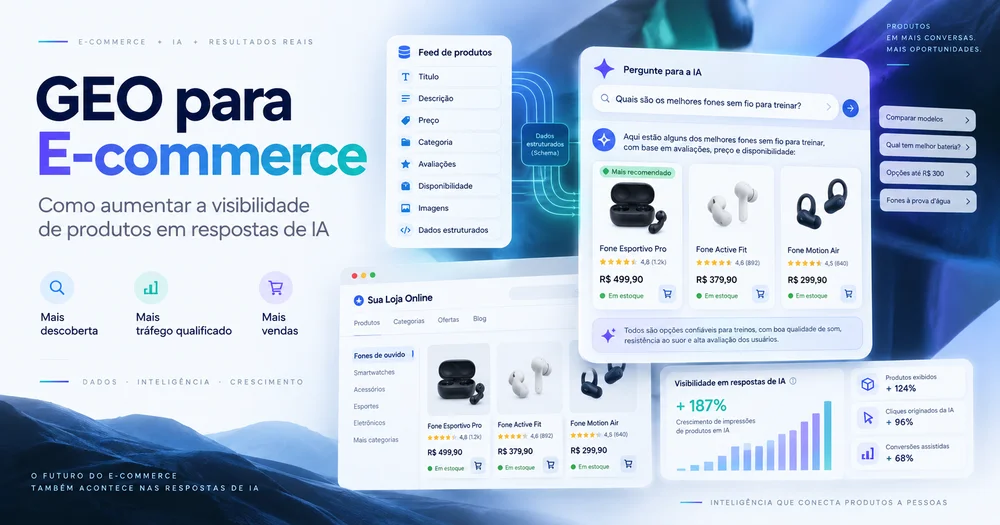
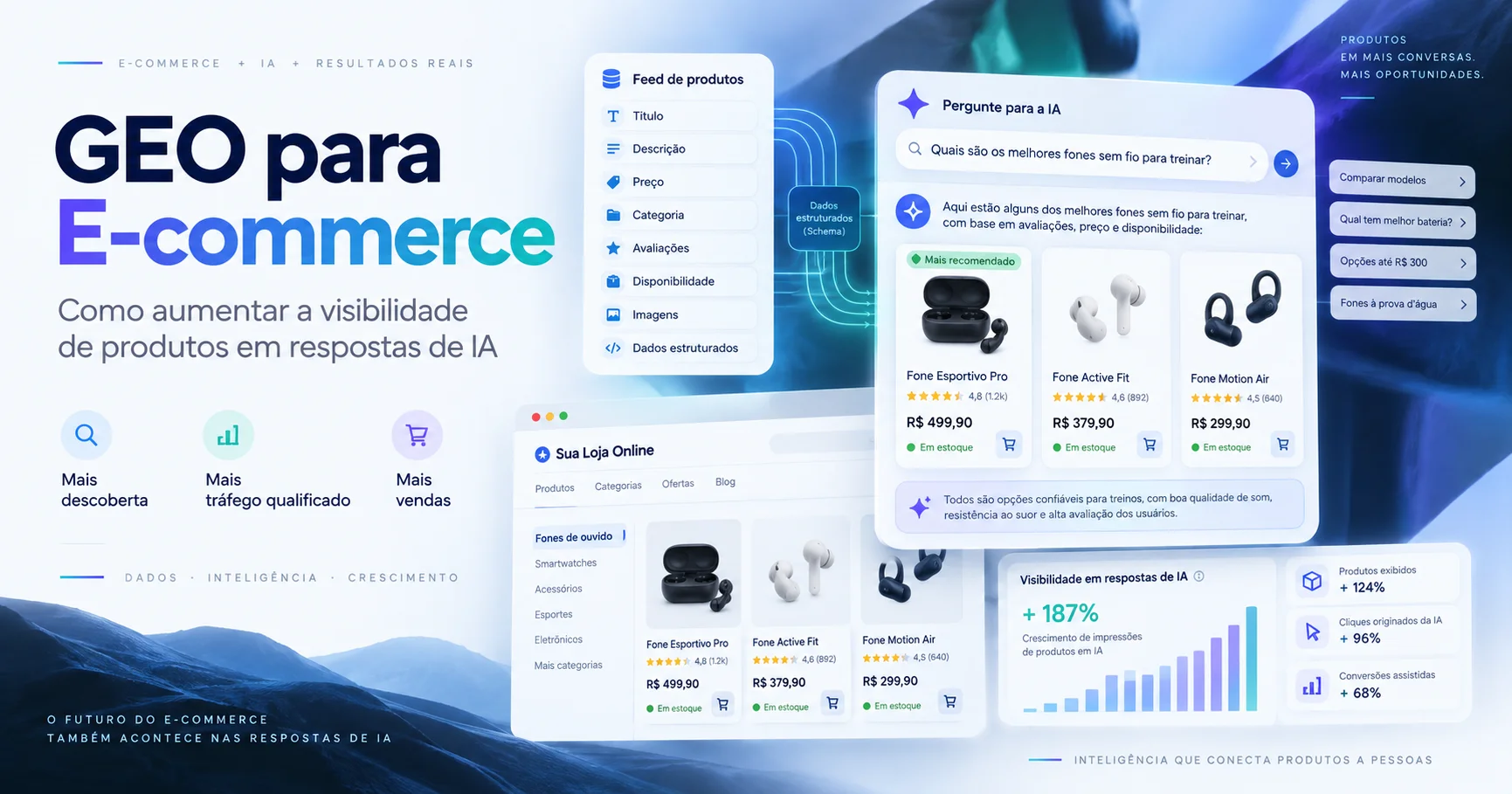
The goal isn't just to "show up in AI". It's to be discovered, compared, cited, and to drive visits and conversions
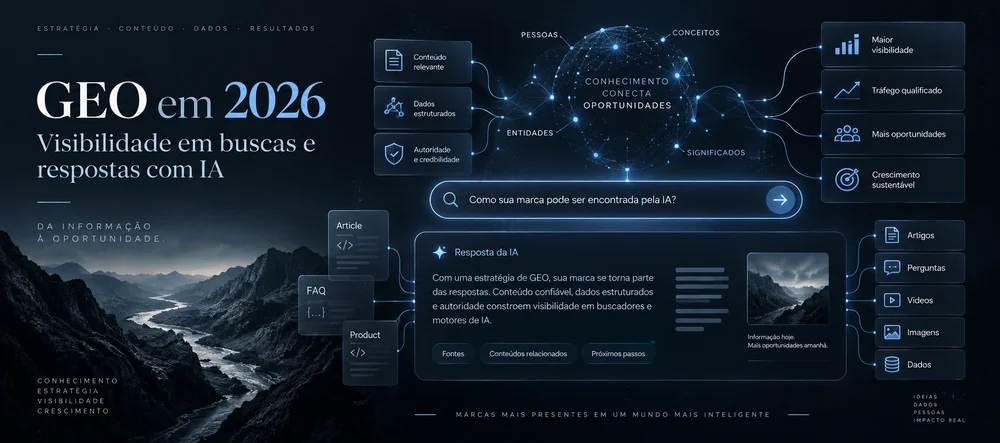
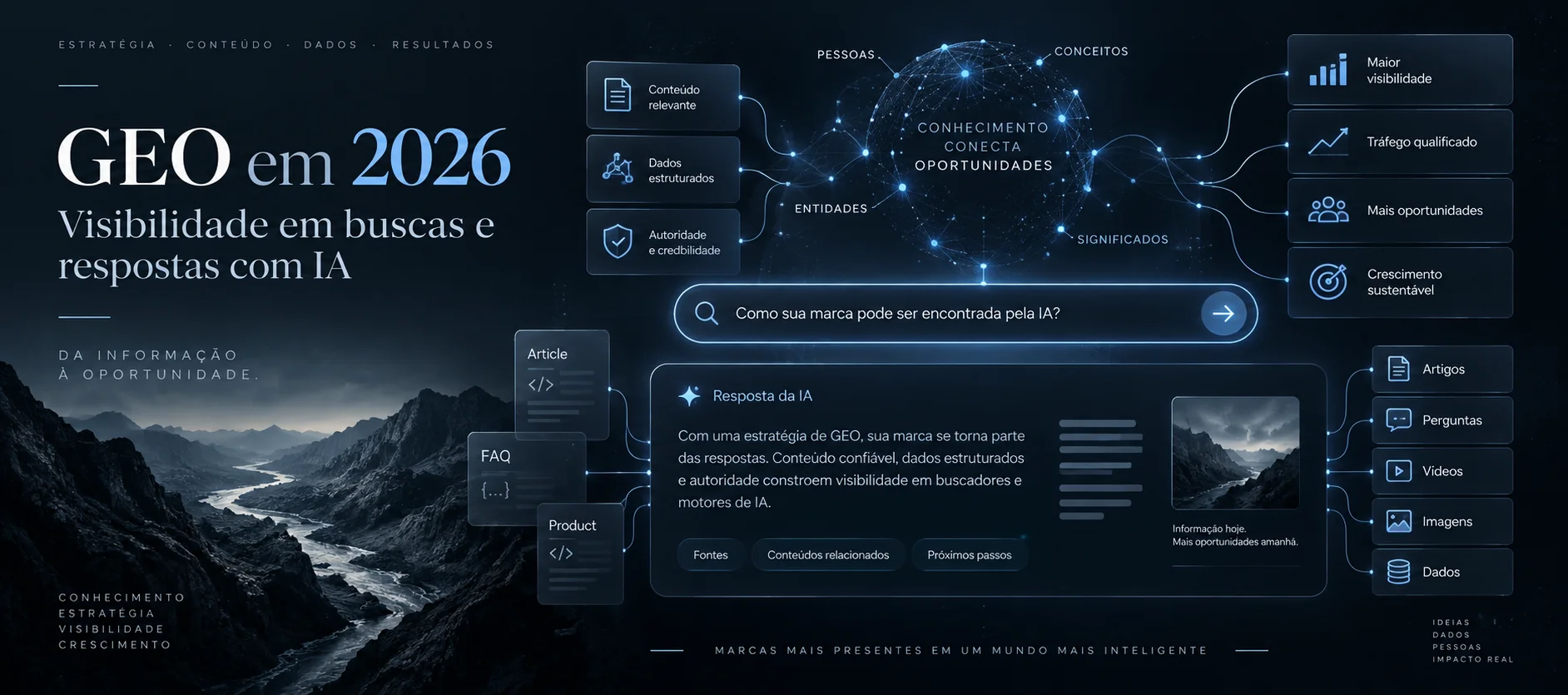
In 2026, a large part of the purchase journey happens inside systems like ChatGPT, Claude and Google's generative experiences before a click ever reaches a site. For an online store, that changes what being found actually means: it's no longer enough to rank well — the product also needs to be understood, compared and cited by systems that combine search, information retrieval and generative models.
GEO (Generative Engine Optimization) applied to e-commerce is not a general AI-optimization guide adapted for stores. It's a discipline with its own moving parts — catalog feeds, structured product data, commercial integrations and verifiable reputation — that a generic GEO guide doesn't cover in depth.
What GEO Changes in the Purchase Journey
A product search rarely starts and ends in the same place. A shopper might search on Google, ask ChatGPT for a recommendation, compare options with Claude, or ask an assistant about a category before deciding where to buy. For an online store, that means visibility no longer depends solely on a position in a results page.
| Before | With GEO for e-commerce |
|---|---|
| Showing up well ranked | Being discovered, compared, cited, and driving a visit or conversion |
| Optimizing a single page in isolation | Making sure product data, price and stock are correct and accessible |
| Crawlers as the only discovery channel | Crawlers plus feeds and commercial integrations |
| Brand authority in general | Reviews, reputation and consistent commercial data per product |
The goal isn't just to "show up in AI". It's to be discovered, compared, cited, and to drive visits and conversions.
How ChatGPT, Claude and Google Discover Information and Products
For ChatGPT, e-commerce shouldn't be treated as simply a matter of allowing crawling by OAI-SearchBot. In 2026, product discovery also involves commercial integrations and structured feeds: OpenAI has announced expanded product-discovery experiences in ChatGPT and explained that merchants can share product feeds through the Agentic Commerce Protocol (ACP), along with catalog integration for merchants on compatible platforms.
The simple logic of "crawlable site → ChatGPT finds it → product shows up" isn't enough for e-commerce. The more complete approach combines crawlable content, catalog and commercial data, feeds where applicable, product-page quality, reputation and relevance to the query.
| Platform | Relevant documented mechanisms |
|---|---|
| ChatGPT | OAI-SearchBot, web search, references and, for commerce, ACP/product feeds |
| Claude | ClaudeBot for automated crawling; Claude-User for user-initiated retrievals; Claude-SearchBot for search |
| Google / Gemini | Search index, ranking systems, Merchant Center, product data and generative features |
A common naming correction is worth noting: Anthropic documents these three agents separately — there is no single crawler called "Claude-Web-Crawler". Always check the official documentation current at the time of implementation.
What Makes a Product Understandable to Search Engines and AI
A product page can load perfectly for a person and still be hard for an automated system to interpret. Much of the difference comes down to how the essential content is delivered — name, description, category, price, availability and variants need to exist clearly in the content the system actually processes.
Essential content must be accessible, renderable and reliably crawlable. Sites that depend heavily on client-side rendering require additional technical validation to make sure crawlers and automated systems can actually access the important information.
In practice, this involves:
- Product name, description and category available in the rendered HTML
- Price, availability and variants (size, color, model) clear and up to date
- Category hierarchy and navigation consistent with the catalog
- Images with descriptive alt text
- Customer reviews and questions, when they exist, visible on the page itself
Product Data: Product, Offer, Price, Stock, Shipping, Variants and Reviews
Structured data makes commercial information more explicit for systems that use it. Google documents support for Product, Offer and other e-commerce data — name, price, currency, availability, condition, aggregate rating and identifiers like GTIN or SKU, among other applicable properties. For other assistants, don't treat Schema as a guarantee of citation; use it mainly as part of a consistent, machine-readable data architecture.
| Property | What it communicates |
|---|---|
| name / description | Product identity |
| offers (Offer) | Price, currency, availability and condition |
| priceValidUntil | How long a price condition is valid |
| itemCondition | Whether the product is new, used or refurbished |
| aggregateRating / review | Average rating and customer reviews |
| sku / gtin | Unique product identifiers |
Markup must reflect exactly what the page shows. Price, stock and availability declared in Schema but out of date on the page create inconsistency — and inconsistency is the opposite of what GEO is trying to solve.
Feeds: Merchant Center, ChatGPT/ACP and Catalogs
Beyond what a crawler finds on a page, much of commercial discovery in 2026 runs through feeds — structured files that describe the catalog directly to the platform.
Google Merchant Center: Receives the store's product feed and powers Google shopping experiences, including price, availability and attribute data used by Product and Offer.
ChatGPT and the Agentic Commerce Protocol (ACP): OpenAI documents that merchants can share product feeds through ACP, along with catalog integrations for merchants on compatible platforms — an additional layer beyond discovery through traditional crawling.
Feeds don't replace a well-structured site. They complement crawling, giving platforms a structured, up-to-date source for the catalog — which reduces how much a system has to "guess" price and availability from the page.
Product, Category and Editorial Content Worth Being Retrieved
Product data solves the commercial side. But many of the questions that come before a purchase are broader than a spec sheet: "which of these two products is better for X", "is it worth buying Y for Z", "what's the difference between the versions". Editorial content — buying guides, comparisons, well-written category pages — is what answers that kind of question.
- Category pages with clear comparison criteria, not just a product grid
- Buying guides that answer real questions before the decision
- Comparisons with explicit criteria between products or variants
- Direct answers to frequent questions about use, size, compatibility and warranty
This kind of content has one advantage over an isolated product listing: it can be cited as a source for a decision, not just as a search result for a product name.
Crawlability and Bot Control
Before any content or data strategy, an e-commerce site needs to make sure the relevant crawlers can actually access what they need. That means confirming that the WAF, CDN and anti-bot protections aren't blocking legitimate agents by mistake, and that robots.txt reflects each platform's current official documentation.
| Platform | Documented agent(s) |
|---|---|
| OpenAI / ChatGPT | OAI-SearchBot |
| Anthropic / Claude | ClaudeBot, Claude-User, Claude-SearchBot |
| Googlebot |
These agents' names and behavior can change. Always check each platform's official documentation at implementation time rather than reusing a fixed list.
Traffic coming from ChatGPT results can arrive tagged with utm_source=chatgpt.com in analytics tools, which helps separate this channel from other referrers.
Reputation, Reviews and External Validation
Authority for an e-commerce site doesn't come from the store alone. Customer reviews, consistent commercial data (name, address, exchange policy, delivery times) and external mentions help AI systems validate that a brand is trustworthy before recommending it.
- Product and store reviews visible and consistent across channels
- Shipping, exchange and return policies clear and easy to find
- Institutional information consistent across the site, marketplaces and social media
- Mentions and comparisons in external sources relevant to the segment
How to Measure Visibility and Revenue Coming from AI
Manual testing is still useful for observing Share of Answer, brand presence and how answers behave — but measurement can be organized in layers.
| What to measure | Method |
|---|---|
| Visibility in generative Google | Search Console and reports available for generative experiences |
| Visits coming from ChatGPT | GA4/referral + utm_source=chatgpt.com |
| Mentions/citations in other assistants | A controlled set of prompts, repeated periodically |
| Business results | Sessions, revenue, conversion and revenue per visit |
| Quality of presence | Mention, citation, recommendation, product shown or simple reference |
Avoid treating AI presence as a simple rank 1, 2 or 3. Generative answers can vary between runs, are influenced by query context, change across models and platforms, and don't necessarily have a static SERP — this calls for sampling and periodic observation, not a single query.
Most Common Mistakes
- Treating GEO as a generic guide applied to the store, without considering feeds, product data and commercial integrations
- Presenting impact statistics with no source, period or methodology
- Using incorrect crawler naming, like a "single crawler" from Anthropic that doesn't exist
- Claiming content should "never" depend on JavaScript, instead of making sure the essentials are accessible and crawlable
- Treating Schema.org as a guarantee of citation in any assistant
- Proposing a fixed budget split between SEM, SEO and GEO as a universal rule
- Promising fixed result timelines, like "60 to 90 days"
- Presenting illustrative scenarios as if they were documented real cases
- Claiming there's no advertising associated with AI experiences
Implementation Checklist
- Relevant crawlers (OAI-SearchBot, ClaudeBot, Claude-User, Claude-SearchBot, Googlebot) aren't blocked by mistake in robots.txt, the WAF or the CDN.
- Essential content on each product page (name, price, availability) is accessible without requiring user interaction.
- Structured Product and Offer data reflects exactly the price, stock and condition shown on the page.
- The Google Merchant Center product feed is active and up to date.
- Catalog integrations via the Agentic Commerce Protocol have been evaluated, where applicable to your sales channel.
- Category pages have clear comparison criteria, not just a product grid.
- Buying guides or comparisons exist for the catalog's main purchase decisions.
- Product and store reviews are visible and consistent across channels.
- Shipping, exchange and return policies are easy to find.
- Search Console, analytics with utm_source=chatgpt.com and a fixed set of monitoring queries are set up.
- No page promises a fixed result timeline or guarantees citation by AI.
Frequently Asked Questions
Can I pay for my brand to be cited organically by AI? Organic citation isn't something you buy through GEO. Some platforms already offer advertising formats and commercial experiences tied to products, but advertising and organic recommendation are different mechanisms.
Does GEO replace SEO or paid media for e-commerce? No. GEO shouldn't be treated as a replacement for SEO or paid media. How investment is split depends on the store's maturity, audience behavior and each business's acquisition economics — there's no universal ratio.
Do I need a product feed to show up in AI answers? It's not the only requirement, but it helps. Feeds like Google Merchant Center's and OpenAI's Agentic Commerce Protocol integrations give platforms a structured, up-to-date source for the catalog, complementing what traditional crawling can capture.
Does structured Product data guarantee my product will appear in AI answers? No. It helps systems understand commercial information explicitly, especially on Google, but it doesn't guarantee citation in any assistant. Markup must reflect exactly the content visible on the page.
How long does it take to see GEO results for an e-commerce site? There's no universal timeline. Technical changes can be detected quickly, while consistent patterns of citation, discovery and traffic require longitudinal observation — avoid drawing conclusions from a single query or a single week of monitoring.
How do I know if my store's robots.txt is blocking AI crawlers by mistake? Review the rules applied to agents like OAI-SearchBot, ClaudeBot, Claude-User, Claude-SearchBot and Googlebot, and confirm the WAF, CDN and anti-bot protections aren't blocking them. Always check each platform's current official documentation, since names and behavior can change.
Sources and References
- Powering product discovery in ChatGPT — OpenAI
- Publishers and Developers FAQ — OpenAI Help Center
- Create campaigns from product feeds — OpenAI Help Center
- Does Anthropic crawl data from the web and how can site owners block the crawler? — Anthropic
- AI features and your website — Google Search Central
- Merchant listing structured data — Google Search Central
- Generative AI performance reports — Google Search Central
- Research on AI and the purchase journey — Stefanini
- AI traffic surge to retail sites — Adobe
GEO for e-commerce isn't a general AI-optimization guide adapted for stores — it's about understanding how products are found, how commercial data is interpreted, how feeds complement crawling, how product pages should be structured, and how reputation and external sources help build trust. At Zion Software House, we help e-commerce businesses audit crawlability, structured data, feeds and measurement to become easier to find, compare and cite in search and AI answers. Want to assess your catalog's visibility? Talk to us.